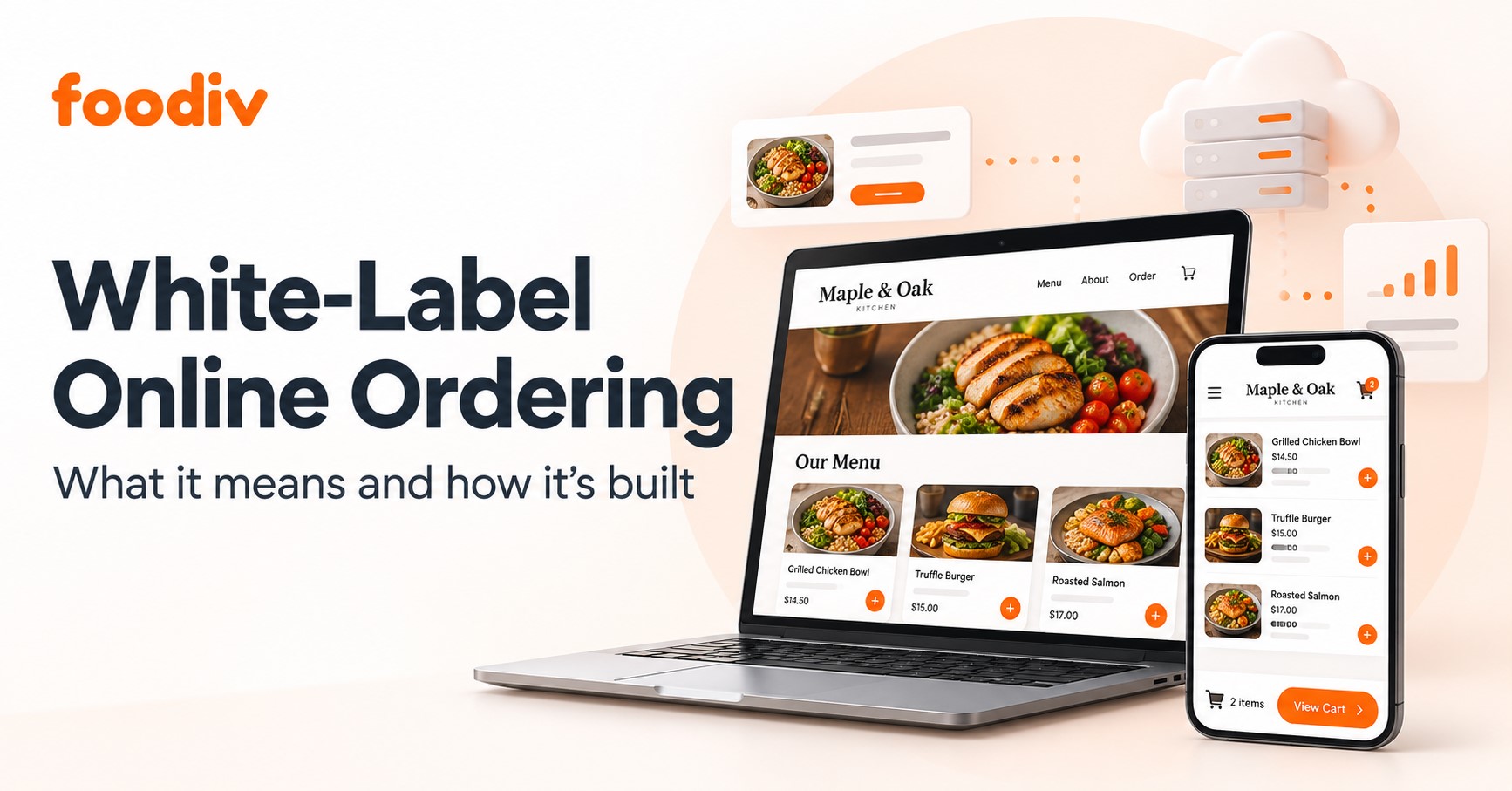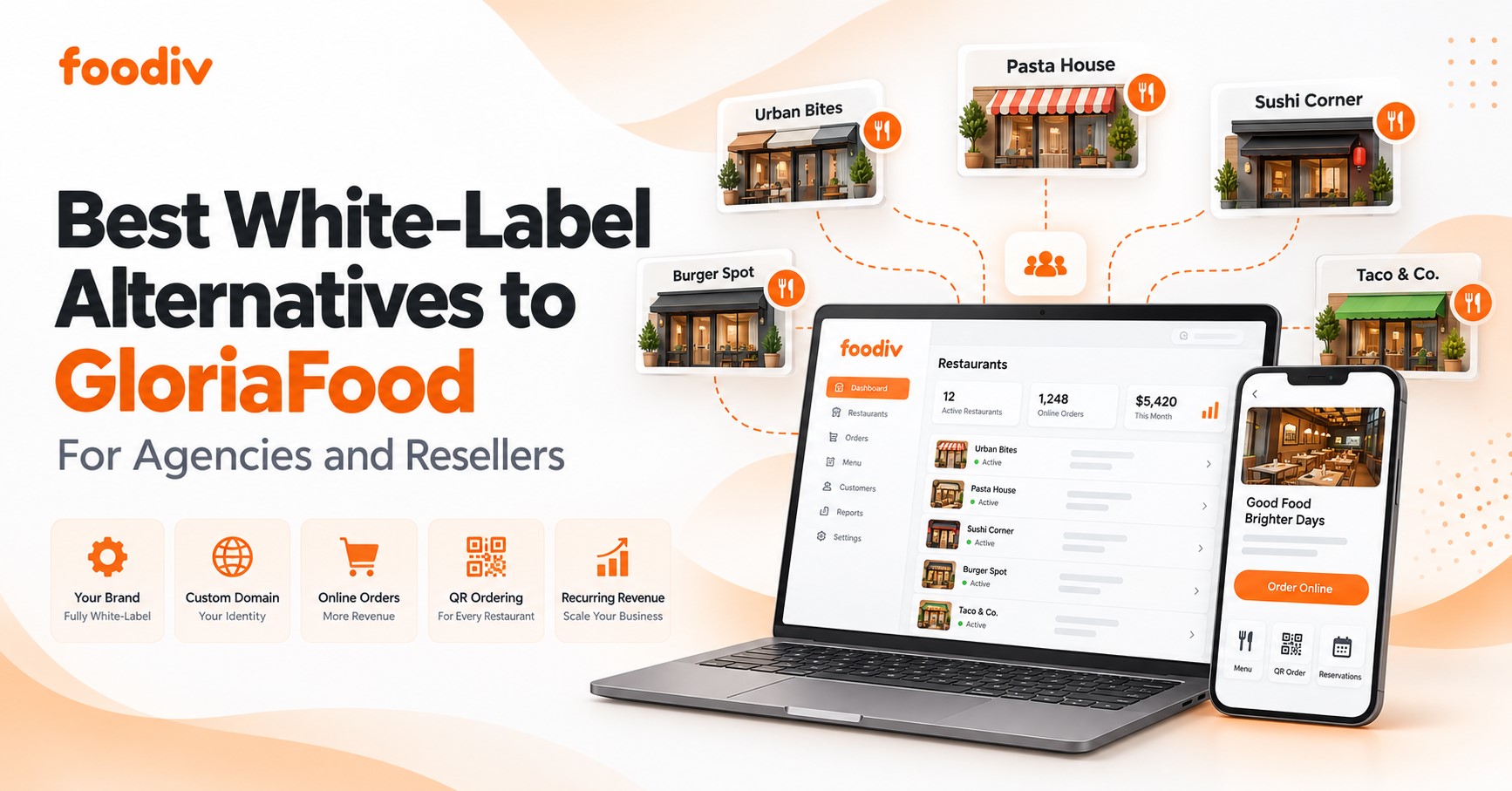
The best white-label alternative to GloriaFood gives agencies genuine control over their brand, domain, client pricing, and restaurant relationships. It should also make it easy to manage multiple restaurant accounts while supporting menu migration, payments, integrations, and technical support.
Foodiv is a strong option for agencies and resellers that want to offer restaurant ordering software under their own brand. It combines white-label branding and pricing control with direct ordering, pickup, delivery, QR ordering, customer management, and GloriaFood menu migration. With GloriaFood scheduled to end service on April 30, 2027, agencies should start testing and planning client migrations early.
Key Takeaways
✓
Choose a genuine white-label partnership, not an affiliate program that only pays referral commissions.
✓
Check whether white labeling covers the domain, ordering page, dashboard, customer messages, and mobile apps.
✓
Make sure you can set your own restaurant pricing and create service packages that fit your clients.
✓
Confirm how the platform handles multiple accounts, restaurant payments, client ownership, and data exports.
✓
Migrate GloriaFood clients in controlled batches so you can test each setup before launch.
✓
Review the partner agreement carefully, especially billing, support, ownership, termination, and account portability.
✓
Consider Foodiv if you want to sell restaurant ordering technology under your own agency brand.
Why Do GloriaFood Agencies and Resellers Need an Alternative?
GloriaFood agencies and resellers need an alternative to protect their restaurant clients, recurring revenue, and brand. Oracle is no longer accepting new GloriaFood sign-ups and plans to end the service on March 31, 2027. Agencies should use this time to compare platforms, test migrations, and move clients carefully.
Protect Existing Restaurant Accounts
If an agency cannot offer a suitable replacement, restaurant clients may search for one independently. That could move the software account, technical support, and wider commercial relationship to another provider. Offering a clear migration plan helps the agency remain a trusted partner.
Maintain Recurring Revenue
A white-label ordering platform gives agencies something they can package with restaurant websites, local SEO, advertising, menu management, and ongoing support. This creates recurring income while giving clients one reliable contact for their digital services.
Preserve the Agency’s Brand
The ordering page, domain, dashboard, emails, and support communication should reflect the agency’s brand where possible. Strong white-label control keeps the agency visible and helps protect the client relationship.
Avoid a Rushed Multi-Client Migration
Moving one restaurant is manageable. Moving 20 involves different menus, payment accounts, delivery zones, printers, integrations, and launch dates. Agencies should start with a small pilot, document the process, and migrate the remaining restaurants in controlled batches.
What Is a White-Label Restaurant Ordering Platform?
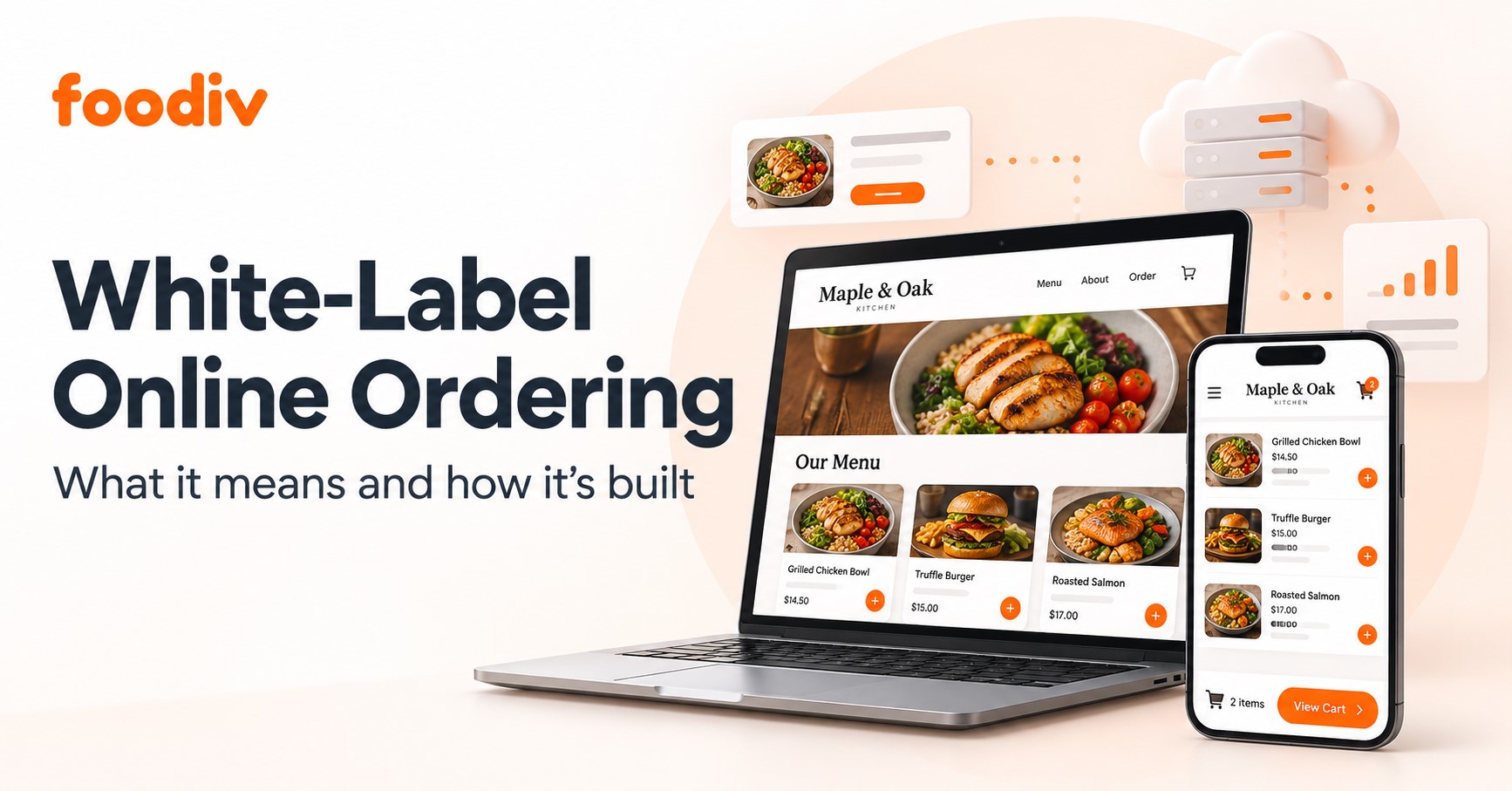
A white-label restaurant ordering platform is software that an agency can customize and sell under its own brand. The underlying provider runs and maintains the technology, while the agency manages its branding, client relationships, pricing, and services.
This model lets an agency offer online ordering without building the entire platform from scratch. Restaurants see the agency’s brand, while the software provider handles the technical system behind it.
Depending on the provider and plan, white labeling may cover:
- Agency logo, brand colors, and visual identity
- Custom domain or subdomain
- Restaurant ordering websites
- Partner and restaurant dashboards
- Branded emails, alerts, and order notifications
- Customer-facing mobile apps
- Sales presentations and marketing materials
- Client billing and first-line support
Here’s the thing: not every platform offers the same level of control. Some only add an agency logo to the ordering page, while others also cover dashboards, apps, emails, billing, and support. Agencies should confirm exactly where the software provider’s name remains visible before signing an agreement.
What Is the Difference Between an Affiliate, Referral, Reseller, and White-Label Program?
These programs differ mainly in brand ownership, pricing control, client management, and how the partner earns money. An affiliate or referral program sends prospects to the software provider. A reseller or white-label model gives the partner more control over the client relationship and revenue.
| Program type |
Who owns the brand? |
Who sets the client price? |
Who manages the client? |
How the partner earns |
| Affiliate |
Software provider |
Software provider |
Software provider |
Referral commission |
| Referral |
Software provider |
Software provider |
Usually the provider |
One-time or recurring referral fee |
| Reseller |
Partner or shared |
Often the reseller |
Usually the reseller |
Markup or wholesale margin |
| White label |
Partner |
Partner |
Partner |
Subscription margin and service fees |
Swipe or scroll horizontally to view the full table on smaller screens.
An affiliate promotes the platform and receives a commission when a restaurant signs up. The provider controls the product, pricing, billing, and customer relationship.
A referral partner introduces qualified leads to the provider. The partner may receive a one-time payment or recurring fee, but usually has limited involvement after the introduction.
A reseller purchases software at a partner rate and sells it to restaurant clients. Resellers often control pricing and support, although the original provider’s brand may remain visible.
A white-label partner sells the platform under its own identity. It can usually apply its logo, colors, domain, packages, and pricing while managing clients directly.
Direct takeaway: Agencies that want to build their own restaurant technology business should generally choose a white-label or reseller model rather than an affiliate-only program.
White-Label GloriaFood Alternatives at a Glance
The right white-label GloriaFood alternative depends on how your agency plans to earn, manage clients, and present the platform. Some providers focus on full branding and pricing control, while others work better for smaller agencies that need ready-made ordering websites, dashboards, and mobile apps.
The table below compares six options. Use it as a starting point, not a final buying decision. Features, migration support, branded apps, account limits, and commercial terms may differ by plan or region. Confirm every detail directly with the provider before signing an agreement.
| Platform |
Best for |
White-label branding |
Custom domain |
Pricing control |
Multi-client dashboard |
GloriaFood migration |
Branded apps |
| Foodiv |
Agencies building their own restaurant SaaS brand |
Yes |
Verify by plan |
Agency sets client pricing |
Yes |
One-Click Bots Migration |
Available |
| Restolabs |
Existing GloriaFood resellers |
Available |
Verify |
Reseller options |
Available |
Guided migration |
Available |
| ActiveMenus |
Web agencies and POS providers |
Available |
Available |
Agency pricing |
Available |
Verify scope |
Available |
| Supaorder |
Agencies wanting brand and invoice control |
Available |
Available |
Partner sets pricing |
Available |
Verify scope |
Available |
| MyOrdering |
Marketing agencies serving restaurants |
Available |
Available |
Verify |
Available |
Verify |
Available |
| Speedoy |
Small restaurant technology resellers |
Available |
Available |
Verify |
Verify |
Verify |
Available |
Swipe or scroll horizontally to view the full comparison on smaller screens.
How We Evaluated the Best White-Label GloriaFood Alternatives
We compared each platform from an agency and reseller perspective. Here are the main factors we reviewed:
Depth of White-Label Branding
We checked whether branding covers only the ordering page or extends to custom domains, dashboards, emails, mobile apps, invoices, and support materials.
Reseller Pricing and Revenue Control
We looked at whether agencies can set their own restaurant prices, create service packages, and keep the resulting margin. We separated genuine reseller models from affiliate programs that pay fixed commissions.
Multi-Restaurant Management
We reviewed how agencies create accounts, assign permissions, switch between clients, manage locations, view reports, and handle billing from one dashboard.
GloriaFood Migration Support
We checked whether providers can transfer categories, menu items, prices, modifiers, variants, add-ons, and images. We also noted which settings require manual setup after import.
Payments and Data Ownership
We considered who controls merchant accounts, customer data, order histories, reports, and exports. We also checked whether each restaurant can connect its own payment account.
Partner Support and Contract Terms
We reviewed onboarding, training, technical escalation, service commitments, and ongoing partner support. We also considered contract terms covering client ownership, termination, data access, account transfer, and what happens when the partnership ends.
6 Best White-Label Alternatives to GloriaFood for Agencies and Resellers
No single white-label GloriaFood alternative suits every reseller model. Foodiv works well for agencies building their own restaurant software brand, while platforms such as Restolabs, ActiveMenus, Supaorder, MyOrdering, and Speedoy address different needs. Compare each option based on branding depth, pricing control, client ownership, migration, integrations, and support.
1. Foodiv: Best Overall for Agencies Building Their Own Restaurant SaaS Brand
Best for
Agencies and restaurant technology businesses that want to set their own prices and sell online ordering software under their own brand.
Why Agencies Should Consider Foodiv
Foodiv gives agencies a ready-made restaurant ordering platform that they can present under their own brand. Partners can apply their logo, colors, and domain, then offer the platform to restaurant clients without developing and maintaining the underlying technology.
The agency manages its restaurant relationships and decides what clients pay. A centralized partner dashboard helps agencies work with independent restaurants, chains, hotels, and other multi-location food businesses. The wider system covers direct ordering, pickup, delivery, QR ordering, menu management, loyalty, customer management, and reporting. Foodiv Partner Program
Main White-Label and Ordering Features
- Custom logo, colors, branding, and domain
- Commission-free direct ordering
- Pickup and delivery management
- QR ordering for tables and hotel rooms
- Menu variants, modifiers, and add-ons
- Coupons, loyalty, and customer management
- Multi-location restaurant management
- Payment and POS integrations
- Analytics and reporting
- Branded website and mobile app options
How Foodiv’s White-Label Partnership Works
Foodiv’s current model gives the partner control over branding, restaurant pricing, and client management:
- The partner selects the platform package that fits its target clients.
- Foodiv configures the platform with the partner’s branding.
- The agency onboards and manages its restaurant clients.
- The partner pays Foodiv’s agreed software fee.
- The partner sets its own prices and service packages.
- The partner earns recurring revenue from its restaurant clients.
This model suits agencies that want to build a restaurant technology business rather than earn a fixed referral commission.
GloriaFood Migration Support
Foodiv’s One-Click Menu Migration can import:
- Categories
- Menu items
- Prices
- Variants
- Modifier groups
- Add-ons
The import reduces manual menu rebuilding, but it does not complete the full restaurant setup. The agency must still configure and test taxes, payment methods, business hours, pickup rules, delivery zones, notifications, integrations, website buttons, and QR ordering links before launch. Foodiv GloriaFood migration details
Points to Confirm Before Joining
- Partner-level wholesale pricing
- Minimum restaurant or location commitment
- Custom-domain setup process
- Branded app development and publishing charges
- First-line and technical support responsibilities
- Payment gateways and POS integrations available in each country
2. Restolabs: Best for Existing GloriaFood Resellers
Best for
Existing GloriaFood resellers that want dedicated migration help, white-label options, and a platform built for managing restaurant clients.
Why Agencies Should Consider Restolabs
Restolabs has created a specific offer for GloriaFood resellers. Its white-label program says partners can sell the platform under their own brand while controlling branding and pricing. A reseller dashboard helps partners track and manage restaurant accounts.
The platform also covers direct online ordering, branded restaurant websites, QR ordering, loyalty, analytics, mobile apps, payment connections, and POS integrations. This makes it relevant to resellers that need more than a simple menu and checkout page.
Main Reseller Features
- White-label branding
- Reseller-controlled pricing
- Restaurant management dashboard
- Branded ordering websites
- iOS and Android ordering apps
- QR code ordering
- Loyalty and customer engagement tools
- Payment, delivery, and POS integrations
- Partner marketing materials
- Onboarding and technical assistance
GloriaFood Migration Support
Restolabs promotes guided migration for GloriaFood resellers and says its team assists throughout the move. Agencies should request a written list of the exact fields included in the migration.
Ask whether categories, items, prices, modifiers, images, promotions, customer records, and historical orders transfer. Settings such as taxes, payment accounts, delivery rules, printers, and integrations may still need manual configuration and testing.
Pricing and Revenue Model
Restolabs offers partner pricing and white-label reseller options, but the exact wholesale terms may depend on client volume and required features. Confirm whether the agency can set any retail price or must work within a defined pricing structure.
Points to Confirm
- Wholesale cost per restaurant or location
- Minimum number of accounts
- Full scope of white-label branding
- Migration fields and responsibilities
- Mobile app setup and store fees
- Client ownership and non-solicitation terms
- Support response times and escalation process
3. ActiveMenus: Best for Web Agencies and POS Providers
Best for
Web agencies, POS vendors, payment providers, and restaurant consultants that want to add online ordering to services they already sell.
Why Agencies Should Consider ActiveMenus
ActiveMenus provides a white-label online ordering system and restaurant app that agencies can offer as their own. It fits businesses that already create restaurant websites, manage digital marketing, install POS systems, or provide payment services.
An agency can combine the platform with website design, menu setup, marketing, support, and other monthly services. This makes online ordering part of a larger restaurant technology package instead of a standalone referral product.
Main White-Label Features
- Agency-branded online ordering
- White-label restaurant mobile apps
- Commission-free direct ordering
- Restaurant website integration
- Custom ordering pages
- Takeout and delivery ordering
- Multiple-location support
- Automated restaurant marketing tools
- POS and payment connections
- Agency-focused sales model
Client Management and Revenue Options
ActiveMenus positions its program around agencies selling online ordering under their own brand and earning from those client accounts. Partners should confirm whether they can freely set retail prices, how restaurant subscriptions are billed, and whether ActiveMenus remains visible anywhere in the customer journey.
Agencies should also define who handles menu changes, payment questions, app updates, order issues, and technical support.
Migration Support
ActiveMenus offers a GloriaFood alternative, but agencies should verify whether migration is automated, assisted, or manual. Request a sample migration using a real restaurant menu before planning a large client move.
Points to Confirm
- Agency and wholesale pricing
- Client and data ownership
- Custom-domain availability
- Partner dashboard capabilities
- GloriaFood migration scope
- Supported POS systems and payment gateways
- Branded app publishing and maintenance costs
4. Supaorder: Best for Agencies Wanting Control Over Branding and Pricing
Best for
Agencies, consultants, and POS businesses that want control over their brand, prices, invoices, and restaurant relationships.
Why Agencies Should Consider Supaorder
Supaorder offers one white-label partner model rather than separate referral and reseller tiers. Partners sell under their own brand, set their own price list, issue their own invoices, and handle the first two levels of client support.
Its restaurant platform includes branded web, iOS, and Android ordering, along with delivery, pickup, QR dine-in, loyalty, reporting, and multi-location controls. It also supports two-way POS connections with Clover, Square, and Toast, according to its current feature page.
Main Partner Features
- Partner-controlled branding
- Custom colors, logo, domain, and app identity
- Partner-controlled restaurant pricing
- Direct client invoicing
- Deal registration and protection
- Branded demonstration environment
- Partner onboarding and certification
- Multi-location restaurant management
- Web and native mobile ordering apps
- Loyalty, delivery, reporting, and POS tools
Branding and Billing Control
The agency owns the visible brand, creates the client price, and invoices the restaurant. Payments for restaurant orders settle through the restaurant’s own payment account rather than passing through Supaorder.
Here’s the tradeoff: the partner also takes on more responsibility. Supaorder expects partners to manage sales, onboarding, and the first two lines of support. Agencies need an internal team that can handle restaurant questions and daily account issues.
Migration Support
Supaorder has a dedicated GloriaFood migration path and specifically addresses agencies managing several restaurant accounts. Confirm which data can be imported and which operational settings must be rebuilt.
Points to Confirm
- Wholesale pricing and margin structure
- Certification requirements
- Support workload and escalation rules
- Location targets tied to territory protection
- Country-specific payment and POS support
- Data export and termination terms
5. MyOrdering: Best for Marketing Agencies Serving Independent Restaurants
Best for
Marketing and web agencies that want to add branded direct ordering to services for independent restaurants and smaller groups.
Why Agencies Should Consider MyOrdering
MyOrdering presents itself as a commission-free restaurant ordering platform with a white-label option for partners. Agencies can customize branding elements such as logos, colors, and domain names, then provide restaurants with a direct ordering channel under the agency’s identity.
This can work well for agencies that already manage restaurant websites, local search, social media, promotions, and customer campaigns. The ordering platform becomes another service inside the agency’s existing monthly package.
Main White-Label Features
- Agency logo and brand colors
- Custom domain options
- Branded restaurant ordering experience
- Restaurant management tools
- Direct, commission-free ordering
- Customer-facing mobile ordering
- Multi-client capabilities
- Promotional and customer engagement options
Partner Support and Marketing Resources
Before choosing MyOrdering, ask what onboarding, sales materials, demonstrations, training, and technical support partners receive. An ordering system may be easy to sell, but the agency still needs a repeatable process for setting up menus, payments, domains, and restaurant staff.
Partners should also clarify whether the dashboard carries their branding and whether customer emails, notifications, invoices, and help materials can use the agency’s identity.
Migration Support
Public information about dedicated GloriaFood migration is limited. Ask MyOrdering whether it can import categories, menu items, prices, modifiers, variants, images, and add-ons. Run a pilot migration before committing several restaurants.
Points to Confirm
- Reseller pricing and minimum commitments
- Freedom to set restaurant prices
- Depth of dashboard and communication branding
- Multi-client account controls
- Mobile app ownership and publishing costs
- Migration process and supported data
- Payment, POS, and printer availability by country
6. Speedoy: Best for Smaller Restaurant Technology Resellers
Best for
Smaller restaurant technology providers that want to explore branded online ordering, delivery management, and POS-related tools.
Why Agencies Should Consider Speedoy
Speedoy offers restaurant-focused online ordering and operational tools. Its published content emphasizes helping restaurants run their own ordering channel, strengthen their brand, and manage customer service and daily operations.
It may interest smaller providers looking for an ordering system with restaurant management capabilities. However, its current public information does not explain its reseller and white-label model as clearly as the other platforms in this list. Agencies should treat Speedoy as an option to investigate, not a confirmed fit.
Main Reseller Features to Verify
- Agency-level white-label branding
- Custom domain and ordering website
- Branded customer mobile apps
- Partner or multi-client dashboard
- Restaurant account creation and permissions
- Reseller-controlled pricing
- Direct delivery management
- Reporting and customer management
- Marketing and loyalty tools
Restaurant Ordering and POS Capabilities
Speedoy discusses restaurant ordering, employee management, branding, and operational workflows. Agencies should request a live demonstration showing the full order journey from the customer’s device to the restaurant dashboard, printer, POS, or kitchen system.
Migration Support
Speedoy does not clearly publish the scope of a dedicated GloriaFood migration service. Ask whether the team provides bulk menu imports, manual assistance, or a structured migration process for resellers with multiple clients.
Points to Confirm
- Whether an active reseller program is available
- Actual depth of white-label branding
- Geographic and language coverage
- Wholesale and per-location pricing
- Multi-client dashboard functionality
- Supported payment gateways and POS systems
- Migration capacity for several restaurants
- Onboarding, support, data ownership, and exit terms
The right choice comes down to control and fit. Foodiv is a strong all-round option for agencies building their own restaurant SaaS brand. Restolabs has clear positioning for existing GloriaFood resellers, ActiveMenus fits agencies and POS providers, and Supaorder offers a more demanding partner model with strong commercial control. MyOrdering may suit smaller marketing agencies, while Speedoy requires more direct verification before it can be treated as a confirmed white-label reseller platform.
What Should Agencies Compare Before Choosing a White-Label Platform?
Agencies should compare more than features and monthly prices. A suitable white-label platform must give the agency clear control over branding, pricing, client relationships, data, billing, and account transfers.
The checklist below can help you find restrictions before they affect your clients or profit margin.
| Area to Compare |
What to Check |
Why It Matters |
| White-label coverage |
Ordering website, custom domain, dashboards, mobile apps, emails, notifications, invoices, help documents, and support communication |
Partial branding may expose the underlying software provider |
| Pricing model |
Wholesale fees, per-location charges, transaction fees, setup costs, app charges, integrations, and minimum commitments |
Unexpected costs can reduce the agency’s profit margin |
| Client ownership |
Contact rights, marketing restrictions, sales permissions, account control, and non-solicitation terms |
Clear terms protect the agency’s restaurant relationships |
| Data control |
Customer exports, order histories, reports, consent records, deletion rights, portability, and contract-end access |
Reliable data access reduces the risk of loss or platform lock-in |
| Billing and support |
Restaurant invoicing, refunds, chargebacks, first-line support, outages, and technical escalation |
Defined responsibilities prevent confusion when problems arise |
| Exit process |
Notice periods, account transfers, data exports, branding removal, app ownership, domain control, and transition support |
A clear exit process helps restaurant clients move without losing access or data |
On mobile devices, swipe horizontally to view the complete table.
How Much of the Platform Is Actually White-Labeled?
Do not assume that adding your logo makes the entire platform white-labeled. Check the ordering website, domain, dashboard, emails, notifications, apps, invoices, documents, and support communication. Ask the provider to show every touchpoint during a live demonstration.
Can You Set Your Own Restaurant Pricing?
Confirm whether you can create your own packages and decide what restaurants pay. Calculate your expected margin after including wholesale fees, transaction charges, app costs, integrations, onboarding, sales, and ongoing support.
Who Owns the Restaurant Relationship?
The agreement should state whether the provider can contact, market to, or sell directly to your restaurant clients. Look for clear account ownership and non-solicitation terms.
Who Owns and Controls the Data?
Confirm who controls customer information, order histories, reports, and consent records. Check export formats, deletion rights, portability, and access after the agreement ends.
Who Handles Billing and Support?
Define who invoices restaurants, processes refunds and chargebacks, answers daily questions, responds to outages, and escalates technical problems.
What Happens When the Partnership Ends?
Review notice periods, account transfers, data exports, branding removal, app ownership, domain control, and transition support. These terms help protect the agency and its restaurant clients if the partnership ends.
Final Verdict: Which White-Label GloriaFood Alternative Should Agencies Choose?
The right white-label GloriaFood alternative depends on how much control your agency needs. Compare each provider’s branding coverage, pricing model, client ownership, multi-restaurant dashboard, migration support, integrations, and contract terms. Restolabs may suit existing GloriaFood resellers, ActiveMenus fits web and POS providers, and Supaorder works for partners prepared to manage billing and frontline support.
Foodiv is a best overall choice for agencies that want to build their own restaurant technology brand. It lets partners use their own branding, set restaurant pricing, manage multiple clients, and offer direct ordering, pickup, delivery, QR ordering, loyalty, and reporting. Its One-Click Menu Migration also reduces manual work when moving GloriaFood menus. Before signing, confirm wholesale costs, supported integrations, app charges, support duties, and exit terms. Then test the complete setup with a small group of restaurants before migrating every client.