Editorial disclosure: Foodiv publishes this comparison and is one of the alternatives listed. We used the same criteria to evaluate every platform.
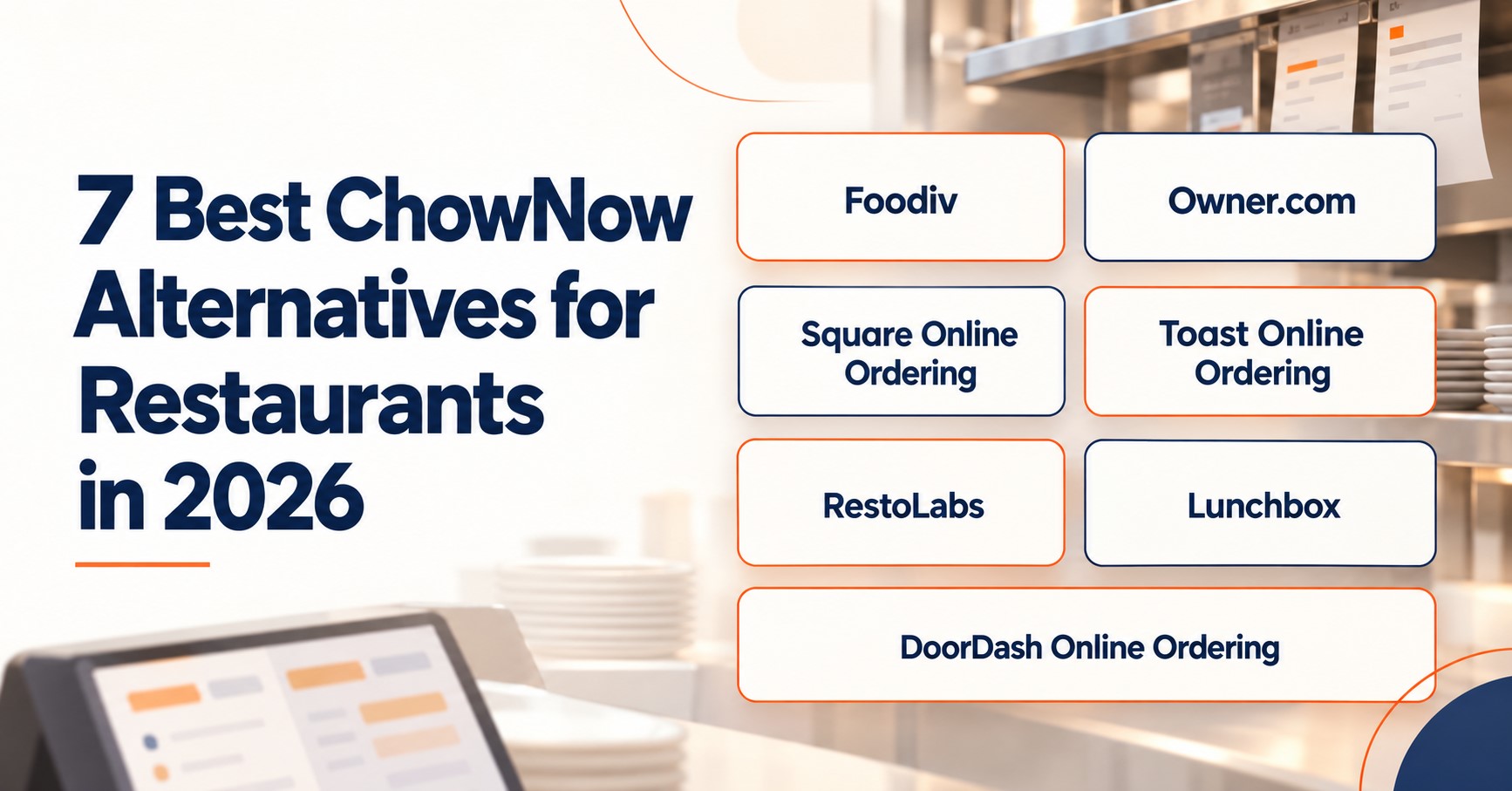
If you’re comparing ChowNow alternatives in 2026, start with the problem you want to solve. Foodiv pairs direct ordering with restaurant operations. Owner.com focuses on repeat-customer marketing. Square and Toast are practical choices if you already use their POS systems. RestoLabs offers customizable direct ordering, Lunchbox supports restaurant groups, and DoorDash Online Ordering serves active DoorDash merchants.
ChowNow built its reputation on a simple promise. It helped restaurants accept online orders without relying completely on third-party marketplaces.For many independent restaurants, it offered a way to take direct orders through their own websites while avoiding heavy marketplace commissions. That model still makes sense. It gives restaurants more control over how customers order and helps them build repeat business.
Here’s the thing. What a restaurant needs from an ordering platform can change. Subscription fees, payment processing, delivery costs, and add-ons all affect the total bill. Some restaurants want more control over branding or a better fit with their POS and delivery setup. Others want stronger tools to bring customers back. ChowNow offers options in these areas, but another platform may fit a restaurant’s budget or workflow better.
This guide compares ChowNow alternatives in 2026 based on pricing, branding, delivery, POS integrations, and tools for repeat orders. The goal is simple: help you understand the costs and trade-offs before choosing a platform for your restaurant.
Key Takeaways
- The right ChowNow alternative depends on your restaurant’s size, service model, existing tools, and growth plans.
- Commission-free direct ordering can reduce platform fees, but subscriptions, payment processing, and delivery still affect what you keep from each order.
- Access to customer data can help you bring guests back. Check what information you can use and export before choosing a platform.
- DoorDash Marketplace can help customers discover your restaurant, but its fees and branding limits differ from DoorDash Online Ordering for direct orders.
- Systems that combine ordering with POS and daily operations can simplify work. Check how well they connect with the tools you already use.
- A careful switch reduces the chance of missed orders. Move your menu, set up payments and delivery, update website links, and test the full ordering process before going live.
Which are the top ChowNow alternatives at a glance?
Foodiv is worth comparing if you want direct ordering alongside restaurant operations. Owner.com puts more emphasis on websites and repeat-customer marketing. Square and Toast make sense if you already use their POS systems. RestoLabs offers flexible direct ordering, Lunchbox has separate options for small restaurants and larger groups, and DoorDash Online Ordering suits active DoorDash merchants. The right replacement depends on which ChowNow features your restaurant uses today.
Published prices are in USD where shown. Check fees, plan features, and availability for your location before switching.
| Platform |
Best for |
Replacement scope |
Key capabilities |
Published price and date checked |
Main limitation |
| Foodiv |
Restaurants that want direct ordering and daily operations in one system |
Direct ordering plus QR ordering and operational tools. Loyalty and delivery controls depend on the plan. Check your existing POS and marketing needs. |
Website ordering, QR ordering, online POS, kitchen order tickets, delivery options, and loyalty on Plus |
Standard $129, Plus $349, Premium $649 per year per outlet.
Checked September 29, 2026. |
Several marketing and operations features require Plus or Premium. Confirm integrations for your restaurant. |
| Owner.com |
Restaurants focused on their website, branded app, and repeat orders |
Direct ordering and marketing tools. Check how its order flow connects with your current POS and kitchen setup. |
Website, online ordering, branded app, loyalty, and automated marketing |
Flexible $249/month plus a 5% restaurant fee per order; Flat Rate $499/month. Guests pay a 5% order support fee on both plans.
Checked September 29, 2026. |
Higher monthly cost; the Flexible plan also charges a restaurant fee per order. |
| Square Online Ordering |
Restaurants already using Square |
Direct ordering connected to Square menus and POS. Review separate marketing and loyalty options if you use those tools in ChowNow. |
Branded ordering profile, pickup and delivery settings, menu sync, discounts, and Square POS connection |
No extra cost for an ordering profile; payment processing fees apply.
Checked September 29, 2026. |
Most practical within the Square system; broader marketing needs may require other Square products. |
| Toast Online Ordering |
Restaurants already running Toast POS |
Direct ordering tied to Toast POS and kitchen workflows. Marketing, loyalty, and advanced branding depend on the products selected. |
Online ordering, menu and kitchen sync, pickup and delivery, offers, and optional advanced website features |
Online Ordering price is not listed publicly; request a quote. POS, hardware, and delivery costs may also apply.
Checked September 29, 2026. |
The total price depends on your Toast setup and chosen modules. |
| RestoLabs |
Restaurants seeking branded direct ordering with delivery and POS options |
Direct ordering, with loyalty and delivery integrations available by plan. Confirm which ChowNow marketing and operations tools your chosen plan covers. |
Pickup and delivery ordering, QR ordering, loyalty tools, POS integrations, and optional website and app features |
Vendor guide lists Basic at $69/month, Growth at $99/month, and Pro at $199/month. The live pricing page displays placeholder amounts, so confirm a current quote.
Checked September 29, 2026. |
Features and add-ons vary by plan; the live pricing page does not show usable amounts. |
| Lunchbox |
Restaurant groups comparing ordering, marketing, and order aggregation |
Lunchbox SMB covers direct ordering for small restaurants. Its enterprise offering adds marketing, loyalty, and multi-location tools. Check the products and integrations in your quote. |
Web ordering; enterprise options for apps, marketing CRM, loyalty, catering, and order aggregation |
SMB: free sign-up with no platform commission. Enterprise: request a quote. Confirm any processing and delivery fees.
Checked September 29, 2026. |
The free SMB option does not represent the scope of the enterprise suite. |
| DoorDash Online Ordering |
Active DoorDash merchants that want direct website orders and Dashers for delivery |
Direct ordering, POS connection, and delivery. Broader loyalty and marketing tools sit in separate DoorDash Commerce Platform offerings. |
Website and social ordering links, synced menus, POS integrations, and Dasher delivery |
No monthly fee or commission on direct orders; payment processing applies. Customers pay delivery fees.
Checked September 29, 2026. |
Requires an active DoorDash store. Its direct-order pricing differs from DoorDash Marketplace pricing. |
What are the 7 best ChowNow alternatives for restaurants?
Each platform here solves a different problem. Some fit better with your POS and delivery setup, while others offer more marketing or multi-location tools. Let’s break them down.
Foodiv combines a direct online food ordering system with tools for handling orders, kitchen tickets, and other daily restaurant work.
Best for: Restaurants that want website ordering, pickup, delivery, and in-house operations in one system.
Replacement scope: Foodiv covers direct ordering and several operational needs. Its marketing and delivery features vary by plan, so compare your current ChowNow setup with the Foodiv tier you would actually buy.
Why compare it with ChowNow: Foodiv is worth a look if you want online POS and kitchen order tickets alongside direct orders.
Key capabilities:
- Direct ordering through a restaurant website
- Pickup and delivery order management
- QR code ordering
- Online POS and kitchen order tickets (KOT)
- Delivery partner integration on Standard, with delivery zones and driver management on Plus
- Coupons, reservations, inventory, reporting, and loyalty on Plus; a customer app on Premium
Pros: Public annual pricing makes the base subscription easy to compare. Foodiv says it does not charge a platform commission per order.
Limitations: The Standard plan does not include every tool listed above. Check that your preferred payment gateway, existing POS, and delivery partners work with your setup and location.
Pricing and date checked: Foodiv lists Standard at $129, Plus at $349, and Premium at $649 per year per outlet. Prices and plan features checked September 29, 2026. See its online ordering features.
Choose this if you want direct ordering and restaurant operations together, and the plan you choose supports your payment, POS, and delivery setup.
2. Owner.com
Owner.com pairs direct ordering with a restaurant website, branded app, and tools designed to bring customers back.
Best for: Restaurants that want to invest in their own ordering channels and repeat-customer marketing.
Replacement scope: It covers direct ordering and much of the website and marketing work a restaurant may use ChowNow for. Check the connection to your existing POS and kitchen workflow.
Why compare it with ChowNow: Both platforms support direct orders and marketing, but Owner.com puts its website, app, loyalty, and automated campaigns into one published plan offering.
Key capabilities:
- Restaurant website with online ordering
- Branded customer app
- Loyalty and rewards
- Automated email and text campaigns
- Pages designed to help customers find the restaurant online
- Direct catering orders
Pros: The published plans include the same core features and allow monthly billing without a long-term contract.
Limitations: The Flexible plan adds a restaurant fee to every order. Guests also pay an order support fee on both plans, which you should consider when comparing the customer checkout experience.
Pricing and date checked: The published US Flexible plan costs $249 per month plus a 5% restaurant fee per order. Flat Rate costs $499 per month without that restaurant fee. Owner.com says guests pay a 5% order support fee on both plans. Pricing checked September 29, 2026. The same page lists its website, ordering, app, and marketing features.
Choose this if website quality and repeat-order marketing matter enough to justify the subscription and applicable order fees.
3. Square Online Ordering
Square Online Ordering gives existing Square restaurants a direct ordering profile connected to their menus, POS, kitchen, and customer records.
Best for: Restaurants that already manage in-person sales with Square.
Replacement scope: It can replace direct ordering while keeping orders inside the Square workflow. Check which Square marketing or loyalty products you need to match your current ChowNow plan.
Why compare it with ChowNow: ChowNow can integrate with Square, but Square’s own ordering profile may be simpler if your team already manages menus and orders in Square.
Key capabilities:
- Branded online ordering profile
- Menu and business-hour updates from Square Dashboard
- Online orders routed through Square POS to the kitchen
- Pickup settings and order timing
- Delivery through supported service providers
- Customer Directory with purchase history across sales channels
Pros: The ordering profile has no added monthly fee, and staff can handle online and in-person orders in their existing Square workflow.
Limitations: Square still charges payment-processing fees. A delivery service provider may charge a separate delivery fee, and the restaurant or customer pays it based on how you set up delivery.
Pricing and date checked: Square says its ordering profile has no extra monthly fee. Payment processing and applicable delivery fees still apply. Pricing checked September 29, 2026.
Choose this if you already use Square and want direct online orders to flow through the same POS and kitchen setup.
4. Toast Online Ordering
Toast Online Ordering connects website orders with the Toast menu, POS, and kitchen workflow.
Best for: Restaurants already running Toast POS that want to add or improve direct ordering.
Replacement scope: It covers direct ordering and connects closely with Toast operations. The marketing, loyalty, website, and branding tools available to you depend on your Toast products and package.
Why compare it with ChowNow: ChowNow integrates with Toast, but Toast’s own ordering product may suit restaurants that want to manage the order flow inside one POS system.
Key capabilities:
- Menu information connected to Toast POS
- Online orders sent into POS and kitchen tools
- Pickup, delivery, curbside, and other fulfillment choices
- Branding options for the standard ordering page
- Offers and upsells
- Pro features such as a custom domain, more design options, banners, and marketing pixel integrations
Pros: Staff can manage online orders alongside the Toast orders they already handle. The standard and Pro feature lists make the branding differences clear.
Limitations: Pro is a separate option, and the public product page does not give one price that covers every setup. Confirm the ordering package, payment processing, hardware, and delivery charges in your quote.
Pricing and date checked: Toast asks restaurants to request pricing for Online Ordering. The same page compares standard Online Ordering with Pro. Package details checked September 29, 2026.
Choose this if you already rely on Toast POS and want direct orders to use your current menu and kitchen workflow.
5. RestoLabs
RestoLabs offers branded direct ordering with choices for payments, delivery, and POS connections.
Best for: Restaurants that want to shape their ordering setup around existing payment and delivery tools.
Replacement scope: It covers direct ordering and offers loyalty and other growth tools. POS connections, third-party delivery, a full website, and a branded app depend on the plan or add-ons you select.
Why compare it with ChowNow: RestoLabs is worth checking if payment choice, branding, or a particular delivery integration is central to your decision.
Key capabilities:
- Online ordering for pickup and in-house delivery
- Branded ordering experience
- Support for a range of payment gateways
- POS connections, depending on the plan and integration
- Third-party delivery connections on applicable plans
- QR ordering and loyalty tools
Pros: It offers several ways to configure direct ordering and fulfillment.
Limitations: Its pricing page currently shows “$00” placeholders for plan amounts, so those figures cannot be used as prices. A website, mobile app, or specific integration may change the quote. Ask RestoLabs to confirm the full package in writing.
Pricing and date checked: No verified plan price is available from the current RestoLabs pricing page. Request a current quote that includes the features and add-ons you need. Pricing page checked September 29, 2026.
Choose this if you need flexible direct ordering and can confirm the required integrations, add-ons, and total price before switching.
6. Lunchbox
Lunchbox offers a broad ordering and guest-engagement suite for restaurant groups, alongside a separate direct-ordering option for small restaurants.
Best for: Growing brands that need ordering, marketing, and order management across locations.
Replacement scope: Lunchbox 2.0 covers web and app ordering, marketing, loyalty, and broader group needs. Lunchbox SMB is a separate option for restaurants with one or two locations that mainly need direct online ordering.
Why compare it with ChowNow: Lunchbox deserves a closer look when coordinating menus, orders, and campaigns across locations has become a bigger job.
Key capabilities:
- Branded web ordering
- App ordering in the broader product suite
- Marketing CRM
- Loyalty programs
- Catering tools
- Order aggregation and POS connections for multi-channel operations
Pros: The enterprise offering brings several group-level tools together. Smaller restaurants can also consider Lunchbox SMB without buying the enterprise suite.
Limitations: Do not assume the free SMB option includes the enterprise marketing, loyalty, or aggregation tools. Confirm the products, POS connections, and service fees in your proposal.
Pricing and date checked: Lunchbox SMB advertises free sign-up and no platform commission. Lunchbox does not publish one standard price for its enterprise offering; request a quote and confirm any processing and delivery costs. Details checked September 29, 2026.
Choose this if you run a growing restaurant group and need a quoted package that connects ordering, marketing, and multi-location operations.
7. DoorDash Online Ordering — Best for active DoorDash merchants seeking direct orders
DoorDash Online Ordering lets active DoorDash merchants take orders from their own website and other direct channels, with Dashers available for delivery.
Best for: Restaurants already active on DoorDash that want to add a direct ordering channel.
Replacement scope: It covers direct orders, supported POS connections, and delivery. Restaurants using ChowNow for broader loyalty or marketing should compare those needs with separate DoorDash Commerce Platform products.
Why compare it with ChowNow: If your menu and merchant account are already on DoorDash, this offers a way to add direct ordering within that setup.
Key capabilities:
- Orders from the restaurant’s website
- Ordering links for Google and social channels
- Menu sync with an existing DoorDash Marketplace setup
- Connections to supported POS systems
- Pickup orders
- Delivery by Dashers with order tracking
Pros: There is no monthly software fee or commission on direct Online Ordering orders. Dashers can handle delivery without the restaurant hiring its own drivers.
Limitations: You need an active DoorDash store. Payment processing still applies, and advanced marketing or loyalty tools are separate from the basic Online Ordering offer.
Pricing and date checked: DoorDash says Online Ordering has no monthly fee or commission on direct orders. Restaurants pay payment-processing fees, and customers pay delivery fees. Details checked September 29, 2026.
DoorDash Marketplace is a separate product. It helps customers discover restaurants in the DoorDash app and charges commissions on Marketplace orders. Do not apply its commission rates to direct Online Ordering orders.
Choose this if you are already a DoorDash merchant and want direct website orders with supported POS connections and Dasher delivery.
Why Restaurants Are Looking for ChowNow Alternatives in 2026
Restaurants are not switching platforms casually. Most start exploring competitors when costs, control, or operational flexibility begin to feel restrictive. Here’s what is driving that shift.
Rising Costs and Fee Structure Concerns
Margins in the restaurant business are already tight. When online ordering costs start creeping up, owners notice fast. Subscription fees may look manageable at first. Then come payment processing fees, add ons, delivery integrations, and optional upgrades. What this really means is your true monthly cost often feels higher than expected. For high volume restaurants, even a small percentage difference in fees can translate into thousands of dollars over a year. In 2026, operators want predictable pricing. They want to know exactly what they pay and why. If a platform creates confusion around commissions, processing, or layered charges, many restaurants start looking elsewhere.
Need for Better Branding and Website Control
Restaurants work hard to build a brand. The logo, the menu, the story, the tone. Here’s the issue. Some ordering platforms limit how much control you actually have over the customer experience. Design restrictions, limited customization, and platform branding can dilute your identity. For restaurants investing in SEO and local search, control over URLs and website structure also matters. If customers do not fully associate the ordering experience with your brand, you lose long term loyalty. In 2026, restaurants want ordering pages that feel like an extension of their own website, not a separate system that customers barely connect to the restaurant itself.
Ownership of Customer Data
Customer data is not just a list of emails. It is your growth engine. When guests order directly, restaurants should be able to see who they are, what they order, and how often they return. That data fuels promotions, loyalty programs, and repeat campaigns. Some platforms restrict access or limit how deeply restaurants can use that information. That becomes a problem over time. If you cannot market directly to your own customers, you rely on paid channels again and again. In 2026, operators think long term. They want full visibility into order history and customer behavior so they can drive repeat revenue without depending on third parties.
Delivery Flexibility and Logistics
Delivery has evolved. Some restaurants run in house drivers. Others use third party fleets. Many combine pickup, local delivery, and marketplace exposure. The challenge comes when a platform does not support flexible delivery models. Workarounds create operational friction. Orders get delayed. Staff must manage multiple dashboards. That slows down service and increases mistakes. Restaurants want systems that adapt to their delivery strategy, not the other way around. Whether it is hybrid delivery, zone based fees, or scheduled orders, flexibility matters. In 2026, operators expect their ordering platform to support real world logistics without adding complexity to the kitchen.
Contract Terms and Platform Limitations
Long contracts can feel safe at the beginning. Later, they feel restrictive. Some restaurants realize too late that cancellation terms, upgrade fees, or limited feature tiers lock them into a system that no longer fits their growth stage. That creates hesitation. Owners want clarity before they commit. They want fair contract terms, reasonable flexibility, and the ability to scale features as their business evolves. If a platform limits integrations, restricts customization, or makes it hard to exit, restaurants start evaluating alternatives. What they really want is control. Control over costs, tools, and the direction of their business.
What to Look for in a ChowNow Alternative
Choosing a replacement is not just about switching software. It is about protecting margins, improving operations, and strengthening customer relationships. Let’s break down what actually matters.
Transparent Pricing and Commission Structure
Start with the numbers. If you cannot clearly calculate your monthly cost, that is a red flag. Look for a pricing model that spells out subscription fees, payment processing rates, and optional add ons in plain terms. Some platforms advertise no commission but add layered fees elsewhere. Others rely heavily on per order charges. The real question is this. Can you predict your cost at higher order volumes? A strong alternative gives you cost clarity upfront and keeps surprises out of your P and L statement.
Branded Online Ordering Experience
Your ordering page should feel like your restaurant, not a generic template. That means control over design, domain, layout, and messaging. When customers place an order, they should see your brand from start to finish. If the platform inserts its own identity too aggressively, you dilute trust and loyalty. Strong branding also supports local SEO and direct traffic growth. The goal is simple. Make online ordering feel like a natural extension of your website, not a separate tool that customers barely connect to you.
POS and Payment Integrations
Manual entry kills efficiency. A serious alternative should sync directly with your POS so orders flow into the kitchen without extra steps. Menu updates should reflect automatically. Payment reconciliation should not require guesswork. If staff must juggle dashboards or retype tickets, errors increase and service slows down. Good integration reduces friction. It saves labor time and improves accuracy. Before switching, check whether the platform supports your existing POS and payment setup. Smooth integration protects both operations and guest experience.
Delivery and Pickup Management
Restaurants operate differently. Some rely heavily on pickup. Others manage in house drivers or use third party fleets. A flexible system supports all of it. Look for zone based delivery fees, scheduled orders, curbside pickup options, and hybrid delivery setups. If you must rely on workarounds to manage delivery, the platform is limiting you. What you want is control. Control over how far you deliver, how much you charge, and how you balance direct orders with marketplace exposure.
Marketing and Customer Retention Tools
Taking an order is one thing. Getting that customer to come back is another. The right alternative should give you access to customer contact details, order history, and segmentation tools. Email campaigns, SMS promotions, loyalty rewards, and promo codes should feel built in, not bolted on. If you cannot easily reach your past customers, you will keep paying to acquire new ones. That cycle eats into margins. Strong retention tools help you grow repeat revenue without increasing marketing spend.
Multi Location and Scalability Support
Growth changes everything. A system that works for one location may struggle at five. If you plan to expand, check how the platform handles centralized menu control, location based pricing, and reporting across stores. Can you manage all locations from one dashboard? Can you run location specific promotions without manual duplication? Scalability is not just about handling more orders. It is about maintaining consistency and control as your brand grows.
Data and Reporting Capabilities
Data should guide decisions, not sit unused in a dashboard. Look for clear reporting on sales trends, peak hours, average order value, and repeat purchase rates. You should be able to see which channels drive revenue and which promotions actually convert. If reports are shallow or hard to access, you lose insight. In 2026, restaurants rely on data to refine menus, adjust staffing, and plan marketing. A strong alternative gives you visibility that leads to action, not just charts that look impressive.
Explore This Blog Also :
Lightspeed Alternatives
Toast POS Alternatives for Restaurants
Best GloriaFood Alternative
Final Verdict – Choosing the Right ChowNow Alternative
Here’s the bottom line.
There is no single best ChowNow alternative. There is only the platform that fits your margins, your service model, and your growth plan.
If you want marketplace exposure, a platform like DoorDash gives you reach. If you want direct ordering with strong marketing control, options like Owner.com or Foodiv make more sense. If budget is tight and you need something simple, GloriaFood lowers the barrier to entry. If you are scaling across locations, Lunchbox or a more integrated system becomes important.
The real decision comes down to control. Control over costs. Control over branding. Control over customer data. When you choose a platform that aligns with those priorities, online ordering stops feeling like an expense and starts acting like an asset.
Choose based on long term profitability, not short term convenience.
FAQs About ChowNow Alternatives
The best ChowNow alternative depends on your priorities. If you want marketplace reach, DoorDash may fit. If you want commission free direct ordering with stronger brand control, platforms like Foodiv, RestoLabs, or Owner.com make more sense. Multi location brands may prefer Lunchbox for centralized management. There is no universal winner. The right choice depends on cost structure, delivery model, and long term growth goals.
Several alternatives operate on a subscription model instead of per order commission. Foodiv, RestoLabs, GloriaFood for direct orders, and Easy Order typically avoid marketplace style commissions. That does not mean there are zero costs. Payment processing fees and optional add ons may still apply. The key is predictable pricing without percentage based revenue cuts.
Yes. GloriaFood offers a free core online ordering system with optional paid upgrades. This can work well for small restaurants starting out. However, advanced features such as marketing tools, integrations, or delivery enhancements may require paid plans. Free works best when your needs are simple and volume is manageable.
Small independent restaurants often benefit from simple, low cost systems. GloriaFood works well for tight budgets. Owner.com can help with repeat marketing and customer engagement. If operations and ordering need to live in one place, Foodiv may offer more structure. The right choice depends on whether your priority is cost control, marketing, or operational integration.
Switching can affect SEO if you change URLs or ordering page structure without proper redirects. If handled correctly, you can maintain search visibility. The key is preserving important URLs, setting up redirects, and keeping your website domain consistent. A planned migration protects rankings. A rushed one can cause temporary traffic loss.
In most cases, yes. Many alternatives allow you to embed or integrate a new ordering system into your existing website. This approach helps maintain branding and SEO while upgrading functionality. Before switching, confirm that the new platform supports your website framework and domain setup.
Most modern alternatives support both pickup and delivery. Foodiv, Easy Order, Lunchbox, and RestoLabs offer hybrid models. DoorDash focuses primarily on delivery through its own driver network. The difference is flexibility. Some platforms allow you to control delivery zones and fees. Others rely on marketplace logistics.
Many direct ordering platforms provide access to customer details, order history, and contact information. Foodiv, Owner.com, RestoLabs, and GloriaFood generally support direct data access for marketing and retention. Marketplace platforms like DoorDash limit how much customer data restaurants can use. If customer ownership is a priority, choose a direct ordering model over a marketplace first system.